What software costs against your rate
A monthly bill is easy to read. Its share of your revenue, cost per client and break-even sessions are the numbers that make it useful.
Your session rate is a price you charge. It is not your take-home rate. The software that makes sessions possible, the hours spent selling them, payment fees and unbilled admin all sit between those two numbers.
This page uses three calculations a coach can run from their own invoices. It does not declare a universal “healthy” software percentage, because no large public study establishes one. The platform prices linked below are vendor list prices checked on 23 September 2026; the arithmetic examples are illustrative, not survey results.
Coaching Rates is published by Coachful, a seller of coaching software. Use the worksheets and the vendors’ primary price pages to check any commercial claim here. Coachful pricing is assigned to a person and preserved; use your own assigned amount rather than a static figure on this site.
The short answer
There is no reliable published percentage of revenue that every coach should spend on software. Divide your full monthly software bill by monthly collected coaching revenue, then by active clients. A $150 bill is 5% of a $3,000 month and 1.5% of a $10,000 month; the same tool can be affordable for one practice and heavy for another.
Three pricing models in view
CoachAccountable charges by active client, Paperbell publishes one flat plan, and Kajabi limits products and contacts by tier. These dated captures show their public home pages, not their pricing screens; check each linked pricing page for the current invoice.
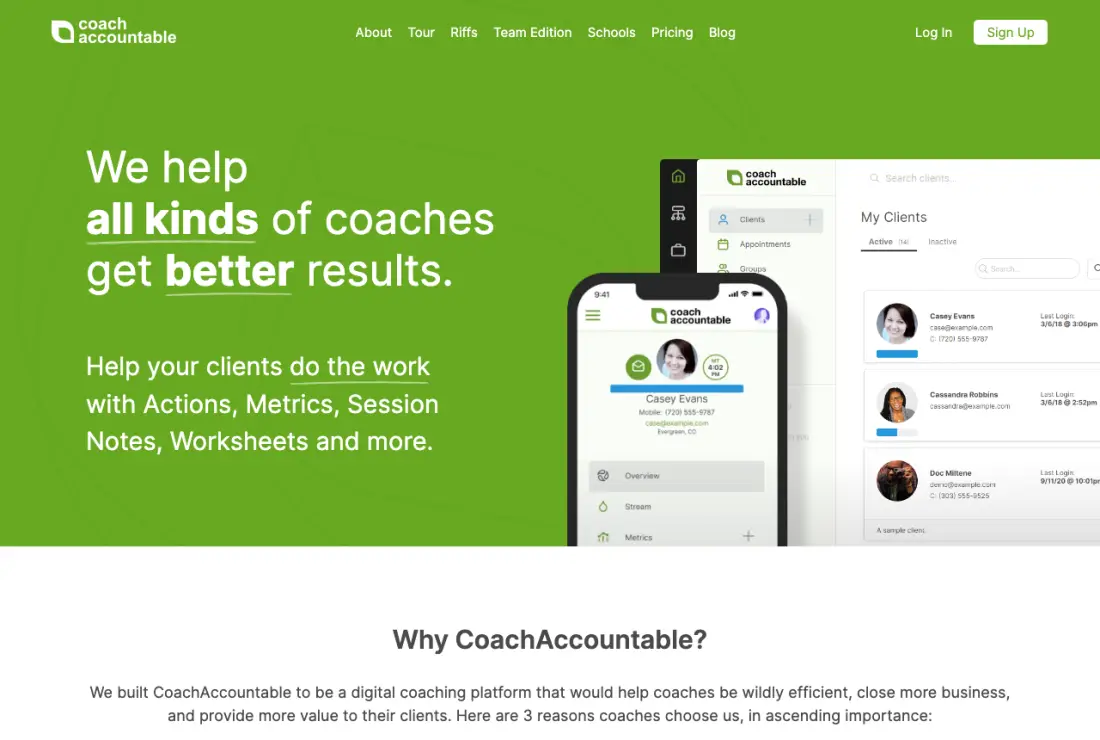


A worked software budget, before tax and payment fees
Rows are hypothetical monthly software bills. Columns are hypothetical collected revenue. Each cell is bill ÷ revenue. A reader can replace both inputs with their own numbers.
| Monthly tools | $3,000 collected | $5,000 collected | $10,000 collected |
|---|---|---|---|
| $50 | 1.7% | 1.0% | 0.5% |
| $150 | 5.0% | 3.0% | 1.5% |
| $400 | 13.3% | 8.0% | 4.0% |
| $600 | 20.0% | 12.0% | 6.0% |
This is arithmetic, not industry data. The $600 row is a scenario roughly in the range of the separate twelve-tool stack example on Coaching Stats, not a claim that coaches typically spend $600.
Calculation two: cost per active client
Divide the full monthly tool bill by the number of clients actually receiving coaching that month. A $57 flat platform across ten clients is $5.70 per client. A $120 plan across twenty is $6.
A $179 platform across ten is $17.90. These figures are subscription allocation, not the total cost of serving a client. Your time, payment fees, customer acquisition and other tools still count.
This calculation reveals why pricing models matter. CoachAccountable’s published schedule rises with active clients: $20 for two, $70 for ten and $120 for twenty. Paperbell’s flat plan remains $57 as client count rises.
Delenta’s portal tiers are $29 for ten, $49 for forty and $79 for unlimited, with additional feature gates. A flat subscription can get cheaper per client as you grow; a client-banded subscription keeps the bill closer to practice size.
Do not use cost per client to choose a platform without testing the work it supports. A system that makes an engagement easier to renew can be worth more than the per-client price difference, but that gain should be observed in your practice rather than asserted by a vendor.
Calculation three: sessions required to cover the bill
At a $150 session price, a $50 subscription takes one session of gross revenue to cover; a $400 stack takes three. That is a quick way to feel the scale. It is not the economic break-even point, because a $150 session also consumes delivery time and may incur processing and tax.
If your contribution after direct costs is $100 per session, the $400 stack needs four sessions.
For a coach selling a three-month package, use the revenue collected per month of service. A $1,500 package delivered over three months contributes $500 of gross revenue a month before costs. A $150 software bill uses 30% of that one client’s monthly package revenue, or 3% of ten such clients’ revenue.
The denominator is the whole practice, not a single sale chosen to make the bill look small.
What the platform list price leaves out
A platform can replace five tools, or simply become the sixth. Write an explicit “cancel” column beside every new capability. If you will keep Zoom for external calls, a dedicated email platform for a large marketing list and a separate course store, include them in the new stack. Savings exist only when old invoices actually stop.
Annual billing requires cash up front. Kajabi Basic lists $179 month-to-month or $1,716 for a year, equivalent to $143 a month. The lower monthly equivalent is a bigger immediate commitment.
Delenta Starter lists $29 monthly or $229 for a year, and Paperbell $57 monthly or $570 annually. Keep annual and monthly numbers in different columns before comparing them.
Payment processing is also separate. Kajabi’s own payment rate and its possible eligible third-party provider fee vary by plan and country. Other platforms may add no platform fee while Stripe or PayPal still charges.
For a coach collecting $10,000 a month, a one-point difference in payment fee is $100 a month, enough to change a close software decision.
A monthly review that takes ten minutes
List invoices
Include annual tools at one-twelfth of the annual charge and note the next renewal date.
Mark what each tool does
Use one job per line: booking, calls, client records, programmes, community, marketing, payment or reporting.
Calculate three ratios
Software divided by collected revenue, software divided by active clients, and software divided by contribution per session.
Cancel verified overlap
Move the workflow first, verify it with a real client, then cancel the redundant tool at its renewal.
Recheck at a threshold
Review when client count, team size or marketing list size crosses a pricing gate, not every time a vendor runs a promotion.
Common questions
What percentage of revenue should a coach spend on software?
No robust public benchmark sets one percentage for every coaching practice. Calculate your own full software bill as a share of revenue collected in the same month, then judge whether each tool supports a workflow you actually use.
Is a $179 coaching platform expensive?
At $3,000 collected monthly it is about 6% of revenue before other tools and fees. At $10,000 it is about 1.8%. Whether it earns its place depends on what it replaces or enables, and whether the quoted tier fits your client and product counts.
Should annual prices be divided by twelve?
Yes for a monthly cost comparison, but record the full annual invoice and renewal date too. The cash outlay and commitment are different from a cancellable monthly plan.
Does no platform fee mean no payment fee?
No. A 0% platform transaction fee does not remove card processor charges. Compare both the subscription and the processor terms for your country and payment mix.
The verdict
A useful software budget begins with your own collected revenue and client load. Price the tier you actually need, include the tools you will keep, and count savings only after an old subscription is cancelled. Recalculate when the practice changes size.